

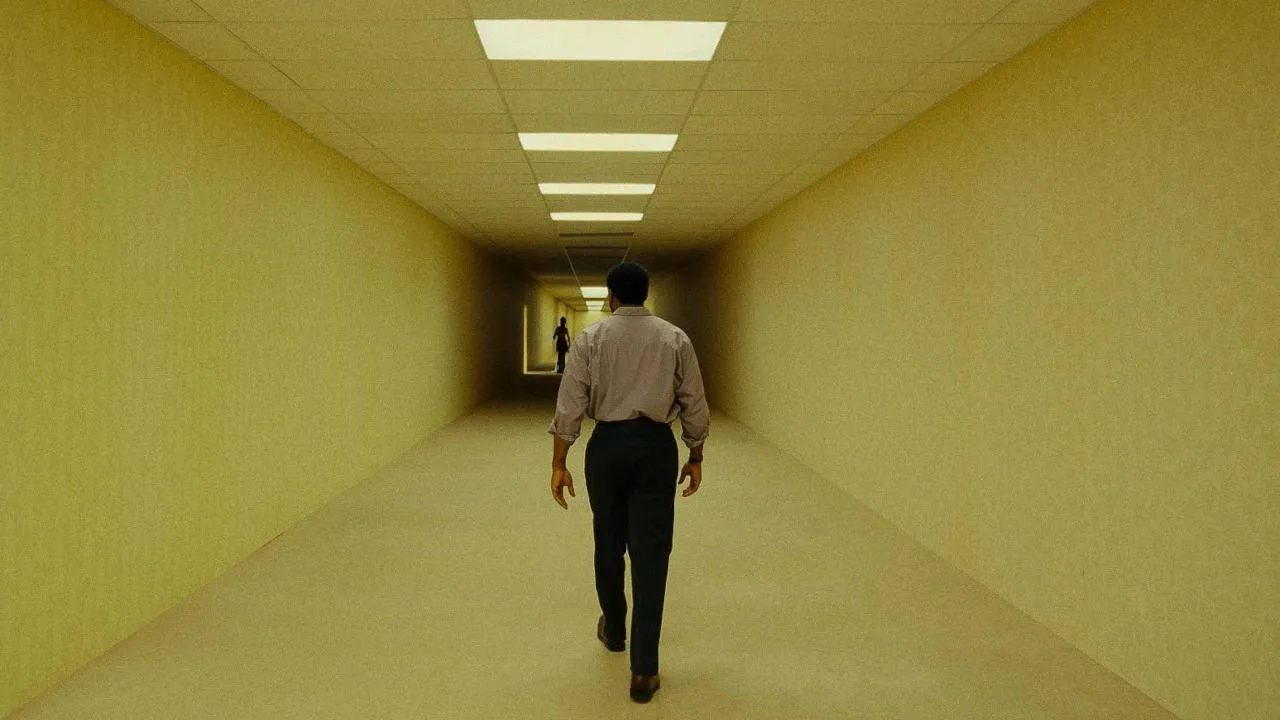
If not for the fact that Backrooms was released two weeks earlier in the US, I would’ve thought it was going to be a pretty divisive film. I know for a fact one my fellow viewers found it pretty boring, having overheard him say he’d wanted to fall asleep in the first 45 minutes.
And I’ll admit that, despite the positive critical reception it’s garnered, it’s not a film for everyone, particularly because of how different it is than your typical supernatural horror flick.
Nonetheless, if you’re able to turn your brain on and tune it to the right frequency for this experience, you’ll be leaving the cinema with a haunting and, perhaps, even delightful feeling of existential dread.
The first thing to get out of the way is that Backrooms is a slow burn. In a race against two snails, it wouldn’t even place in the top three. But that was the smart move given that it’s the silver screen upgrade of what started as a 9-minute found footage-style YouTube short film.
It’s clear that director Kane Parsons knew what he was doing with this adaptation, taking a horror concept that shouldn’t translate well as a feature-length film and, not only making it work, but making it great.
And how he does this is by sticking to a theme that remains pervasive throughout the film, becoming ever more prominent as the plot progresses and topped off by an unsettlingly ambiguous ending. This feat is in turn executed through strangely-relatable protagonists who serve as the audience’s emotional and psychological anchors as we venture into unfamiliar territory.
Backrooms thus owes its success as much to its actors as it does to Parsons and its writer Will Soodik. Chiwetel Ejiofor and Renate Reinsve perfectly embody the different types of horror they’re experiencing throughout the twists and turns in the movie (and there are several kinds presented).
But it’s not just the artistry of the performers that stand out, but the artists behind the set of the film as well. I can’t recall any other horror film where the physical setting was just as eye-catching as the characters and action taking place on screen. It makes Backrooms by far the most artful horror I’ve ever had the pleasure of witnessing.
Here’s the weird thing about this movie though… I didn’t find it scary. At least not in the typical way you get scared when you’re watching ones with a ghost involved. Don’t get me wrong, there are parts of the film that suitably utilise traditional horror sequences, like being chased by entities. However, the film clearly demonstrates a preference for suspending audiences in psychological and existential horror instead.
It does scare you sometimes, but by the halfway point, you’re going to be feeling unsettled and creeped out all the time. Perhaps the best part about Backrooms is the mastery it demonstrates of the uncanny valley style of horror, and you can tell they’ve mastered it because they even do a great job of explaining it to viewers without actually having to say it.

And that might be why, despite not being frightened per se, I can say I enjoyed the film as a proper horror, because it’s the type to haunt the back (or backrooms?) of your mind well after it’s over. It’s hard to put into words, but it’s no easy task to make a horror that, through dialogue, gore, character development, and chase scenes, manages to make audiences leave the theatre with an uneasiness that didn’t stem from any monster in the film, but from what the movie says about existence itself.
(This feels like a good time to issue a warning that this film is not for the faint of heart, especially if you’re at risk of being affected by existential dread and adjacent themes).
The last thing good I’d like to point out about Backrooms is that it’s a movie that deserves at least a second watch, I knew as I was watching a film that there was a lot about it I wasn’t going to understand the first time round. It’s kind of the same feeling you get watching Performance (1970). I wouldn’t be surprised if it soon becomes a piece studied in film classes as a serious piece of literature.
As for its weak points, I felt like it could’ve been just a little more overtly creepy at times. As much as I enjoy slow burns, I might have liked it more if the different parts of the backrooms were made more explicitly “horror” than just bizarre and unsettling. Then it might have helped to create a little more urgency by implying the presence of a looming threat earlier on, making the scenes feel a little more urgent and a little less exploratory.
Review up by Muhd Muhaimin